FIFA and the World Trade Organization released a joint study on the economic impact of two major soccer events being held on US soil. Quick context on what these are, since the names can be confusing:
- FIFA Club World Cup 2025 — a club competition (not national teams), featuring teams like Real Madrid and Manchester City. FIFA expanded it in 2025 into a 32-team tournament (up from a much smaller 7-team format), held across 11 US host cities.
- FIFA World Cup 2026 — the traditional national-team tournament, co-hosted by the US, Mexico, and Canada.
Combined totals:
- $62 billion projected global GDP impact from both tournaments together
- $47 billion in US economic output
- Roughly 290,000 jobs created in the US
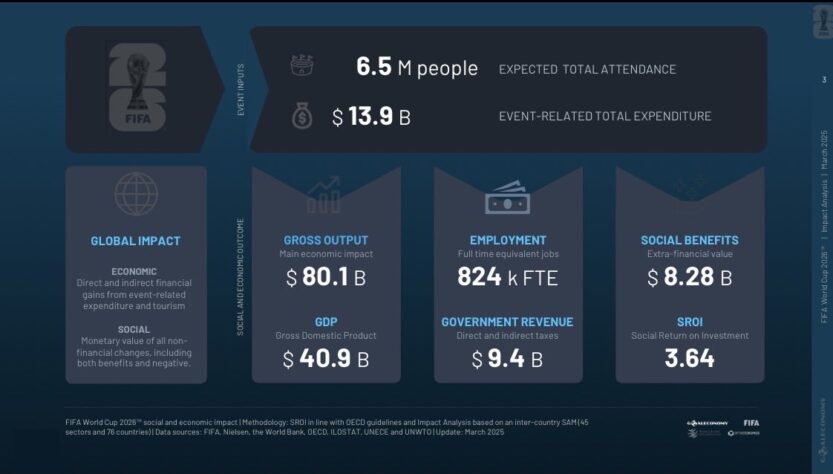
World Cup 2026:
- 6.5 million attendees expected across host countries
- Up to $40.9 billion in global GDP, $8.28 billion in social benefits, ~824,000 jobs worldwide
- US portion: $17.2 billion GDP, $30.5 billion gross output, 185,000 jobs
Club World Cup 2025:
- 3.7 million total attendance across the 11 US host cities
- $21.1 billion in global GDP ($9.6 billion of that in the US)
- $17.1 billion in US gross output, $3.36 billion in social benefits, 105,000 US jobs
The figures come from an independent research firm (OpenEconomics), using an impact-analysis and social-return-on-investment methodology aligned with OECD guidelines. It’s part of a broader FIFA-WTO partnership formalized through a memorandum of understanding signed in 2022.
.@POTUS on the World Cup in America: "My first meeting with Gianni [Infantino]… He had this idea and I said, 'That's crazy. We're not a soccer country' — and it turns out, we are a soccer country." ⚽️🏆🇺🇸 pic.twitter.com/numMGyOcZx
— Rapid Response 47 (@RapidResponse47) July 19, 2026